

To host 64 matches of the World Cup from November 20 to December 18, Qatar used eight stadiums, each featuring its own unique architecture and special design.

The World Cup opened on November 20 at Al Bayt Stadium in Al Khor City.
This stadium has a capacity of 60,000 and was inaugurated in 2021, designed by Dar Al-Handasah. It also hosted one of the tournament’s semifinals. The stadium resembles a giant tent once used by nomadic people in Qatar and the Gulf region. Surrounding the venue is a PTFE (Polytetrafluoroethylene) fiberglass membrane, including a retractable roof that supports advanced cooling technologies. After the World Cup, the 60,000-seat stadium will be reduced to 40,000 seats.
The modular upper tier will be dismantled, and its seats will be reused for sports facilities around the world. Along with the green spaces surrounding the stadium, the upper-tier lounges will be converted into a five-star hotel. In addition, the stadium will incorporate a shopping mall, dining areas, a gym, a multipurpose hall, and a sports hospital.

Lusail Stadium in Lusail City, with a capacity of 80,000, is the largest venue of the 2022 World Cup and the site of the final match. It was designed with consultancy from Foster + Partners and Populous. Inspired by the interplay of light and shadow from lanterns, the stadium’s façade features triangular cladding panels, a steel framework, and decorative motifs reminiscent of patterns found on traditional bowls in the region.
Opened in 2022, the seating is divided into three tiers. The PTFE roof allows sunlight to reach the pitch for grass growth while blocking hot winds and dust, providing shade to reduce pressure on the cooling system. After the tournament, the stadium will be repurposed into a complex including affordable housing, shops, restaurants, a clinic, and schools.

Ahmad Bin Ali Stadium in Umm Al Afaei, with a capacity of 40,000, was designed with an illuminated façade by Ramboll and Pattern Design. Its exterior incorporates motifs symbolizing elements such as the undulating shapes of sand dunes. Inaugurated in 2020, it replaced the old stadium previously located on the same site. More than 90% of the construction materials were reused or recycled from the former venue, and trees were relocated to other areas of the site.
After the World Cup, 20,000 seats will be removed and repurposed for other sporting events. The venue will then serve as the home ground for the local football team.

Al Janoub Stadium in Al Wakrah, with a capacity of 40,000, was designed with inspiration from the sails of traditional wooden dhows once used by the city’s residents for seafaring. Featuring a retractable roof, the stadium—opened in 2019—will serve as the year-round home of the local football club and will be reduced to 20,000 seats after the World Cup.
Its 416-ton roof was built on six temporary towers before being lifted into place and welded permanently. The stadium was designed by AECOM in collaboration with Zaha Hadid Architects.

Al Thumama Stadium in Al Thumama, with a capacity of 40,000, was designed as a stylized representation of the gahfiya, the traditional cap worn by boys and men across the Middle East. Its white exterior stands out against the surrounding greenery. Designed by architect Ibrahim M. Jaidah, the stadium was inaugurated in 2021.
Al Thumama incorporates advanced cooling technology to shield spectators from the intense heat. After the World Cup, 20,000 seats will be removed, and the upper tier will be transformed into a luxury hotel overlooking the pitch.

Education City Stadium in Al Rayyan, with a capacity of 40,000, was designed by Fenwick-Iribarren Architects and Pattern Design and opened in 2020. Its façade is composed of numerous triangles forming a diamond-like geometric pattern that appears to change color as the sun moves across the sky. At night, the exterior transforms into a digital light show.
After the World Cup, 20,000 seats will be removed. The stadium will become part of a community sports center, while the upper tier will be converted into classrooms for nearby universities.

Khalifa International Stadium in Aspire, with a capacity of 40,000, is the only venue that was renovated rather than newly built. Originally constructed in 1976, it was redeveloped in 2017 by Dar Al-Handasah in preparation for the World Cup.
The stadium’s iconic dual arches were preserved, while a wide roof canopy was added with an integrated cooling system. A new tier with 10,450 seats increased the total capacity to 40,000, complemented by an upgraded LED lighting system.

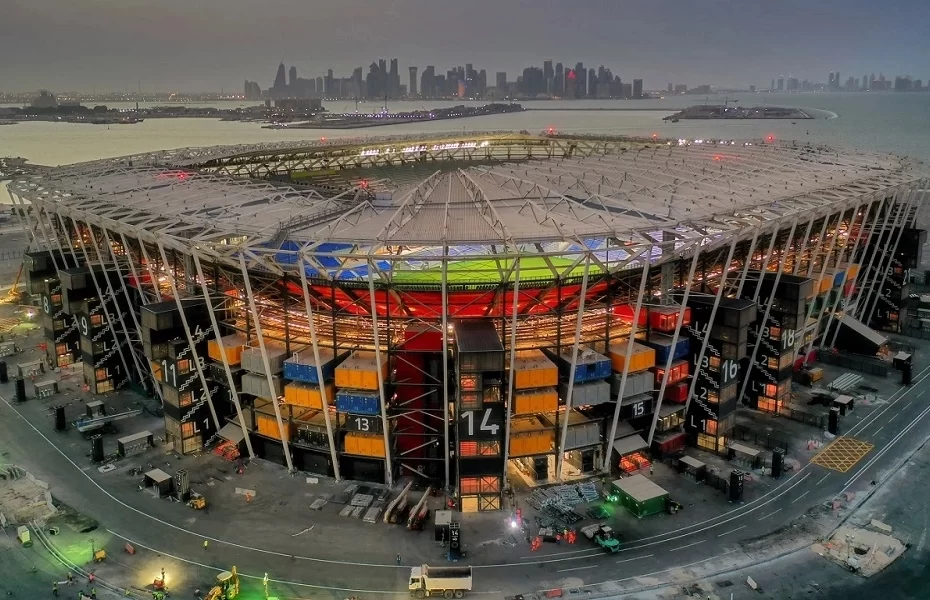
Stadium 974 in Ras Abu Aboud, with a capacity of 40,000, was built entirely from 974 shipping containers and modular steel. It is the first World Cup stadium in the world designed to be fully dismantled after the tournament.
Designed by Fenwick-Iribarren Architects, the stadium features brightly colored standard containers and a modular structure that reduces the need for building materials. Many of the materials used for the stadium, inaugurated in 2021, were transported in the very same containers. Located to capture natural breezes, the seating areas benefit from fresh airflow rather than relying on air-conditioning technology.